

Overview and key points
Tax issues can create uncertainty, delay negotiations and put value at risk. Whether they arise during an M&A process, a restructuring or routine tax risk management, a technical tax position can quickly become a commercial concern.
Tax insurance, sometimes known as tax liability insurance, can help businesses, buyers, sellers and investors transfer an identified but uncertain tax exposure to an insurer. Used well, it can provide greater confidence, support cleaner negotiations and help protect value.
Foreword
Tax insurance isn’t new – insurance providers have been arranging policies to cover potential tax liabilities for over twenty years.
What has changed is the volume and frequency of its use which has led to premiums halving in the last seven years and a far wider scope of what is possible to insure.
In this white paper, our specialist M&A Advisory team provide you with an overview of what it is, how it is being used, and some practical guidance on how to get the best results.
Felix Sloman has been a leading tax insurance adviser in the UK market for 16 years. He has arranged many of the most high-profile tax insurance policies and regularly assists clients of all sizes in the UK.
Introduction: can you insure a house that is already on fire?
It is important to be clear from the outset: tax insurance is not a silver bullet. There are scenarios where insurance will not be available, and it is not intended to support aggressive schemes, structures that are unlikely to withstand sensible scrutiny, or matters that are already the subject of a challenge. Part of our role as broker is to provide early guidance to clients and their advisers on the likely availability of cover, and on the information required to secure a firm quote.
Tax insurance is designed to support conscientious businesses that have taken professional tax advice, but still face uncertainty because the relevant tax authority may disagree with the interpretation or position taken.
A significant proportion of tax insurance enquiries arise in M&A processes, often where a buyer’s tax adviser identifies a potential issue during due diligence. However, it is increasingly common for companies to explore tax insurance as part of their wider day-to-day risk management strategy.
The purpose of the policy is to provide certainty by insuring the theoretical tax liability, together with associated costs. This can include the costs of defending a tax investigation, interest and penalties where insurable, and any gross-up amounts.
In an M&A context, this can help remove the issue from the negotiating table. Outside a transaction, it can help ringfence a potential balance sheet liability.
At a glance
| Purpose | To transfer an identified but uncertain tax exposure from the balance sheet to an insurer. |
| Best suited to | Credible, well-advised tax positions where there is uncertainty, but not a known liability. |
| Common use cases | M&A, restructuring, refinancing, fund activity, real estate transactions and wider tax risk management. |
| Typical timing | Initial insurer feedback may be available in two to three working days; underwriting typically takes two to three working weeks. |
| Typical UK premium range | Most UK tax insurance policies are rated between 1.5% and 5% of the amount of cover required. |
Why does tax insurance matter?
Even where a business has taken professional tax advice and acted in good faith, tax rules can leave room for interpretation. If HMRC or another tax authority takes a different view, the potential impact may include a tax liability, defence costs, interest, penalties where insurable, or a gross-up amount.
In a transaction, that uncertainty can lead to price adjustments, specific indemnities, delays or difficult negotiations. Outside a transaction, it can create a balance sheet exposure that management teams, boards or investors need to address.
What can tax insurance cover?
There is no finite list of scenarios where tax insurance can be used. A more helpful approach is to consider how specialist tax insurers assess the risk. As a rule of thumb, insurers tend to favour risks that are medium-low in likelihood, but where the potential quantum is significant enough that the issue cannot be ignored. In simple terms, the risk itself is very low in likelihood, but if it were to come home to roost, the number/quantum would be so high that they can’t ignore the risk in the context of the deal, because it would fundamentally change the economics of acquisition.
Tax insurance is designed for credible, well-advised positions where there is an identified risk, but not a known liability. It is not intended to support aggressive tax planning, artificial schemes or matters already under active challenge.
Cover may be considered for a broad range of tax matters, including technical interpretation risks, discovery risks and valuation or factual risks.
What type of tax risks can be insured?
There is no set list of what can or cannot be insured. The examples below illustrate some of the more common areas where tax insurance is used:
- Transfer of a Going Concern (VAT) risks
- Corporate reorganisations
- Residency/permanent establishment risks
- Worker classification (employee/contractor)
- Debt-for-equity swaps
- Transactions in UK Land/Trading vs Investment
- Stamp Duty Land Tax (SDLT) risks
- Loan relationships (Corporation Tax)
- Entrepreneur’s relief and Substantial Shareholder Exemption
- Degrouping charges
- Enterprise Management Incentive (EMI) risks
How do insurers assess the risk?
Historically, tax insurance was most commonly used to support technical or interpretation risks. This has evolved, with more insurers willing to consider other types of risk where the fact pattern or mitigating circumstances are compelling. Some insurers are also prepared to consider future events, rather than only historic tax positions, such as planned restructurings, provided the insured follows the agreed steps correctly.
Risks are often a combination of these categories. Tax insurance can be used for a wide range of tax risks. These typically fall into the following categories:
- Technical/Interpretation Risks – uncertainty around the application of the tax law or guidance when applied to the specific circumstances (grey areas).
- Discovery Risks – uncertainty as to whether the tax authority will investigate or identify the area of uncertainty.
- Valuation/Factual Risks – uncertainty around the correct calculation of a liability, or around substance, for example.
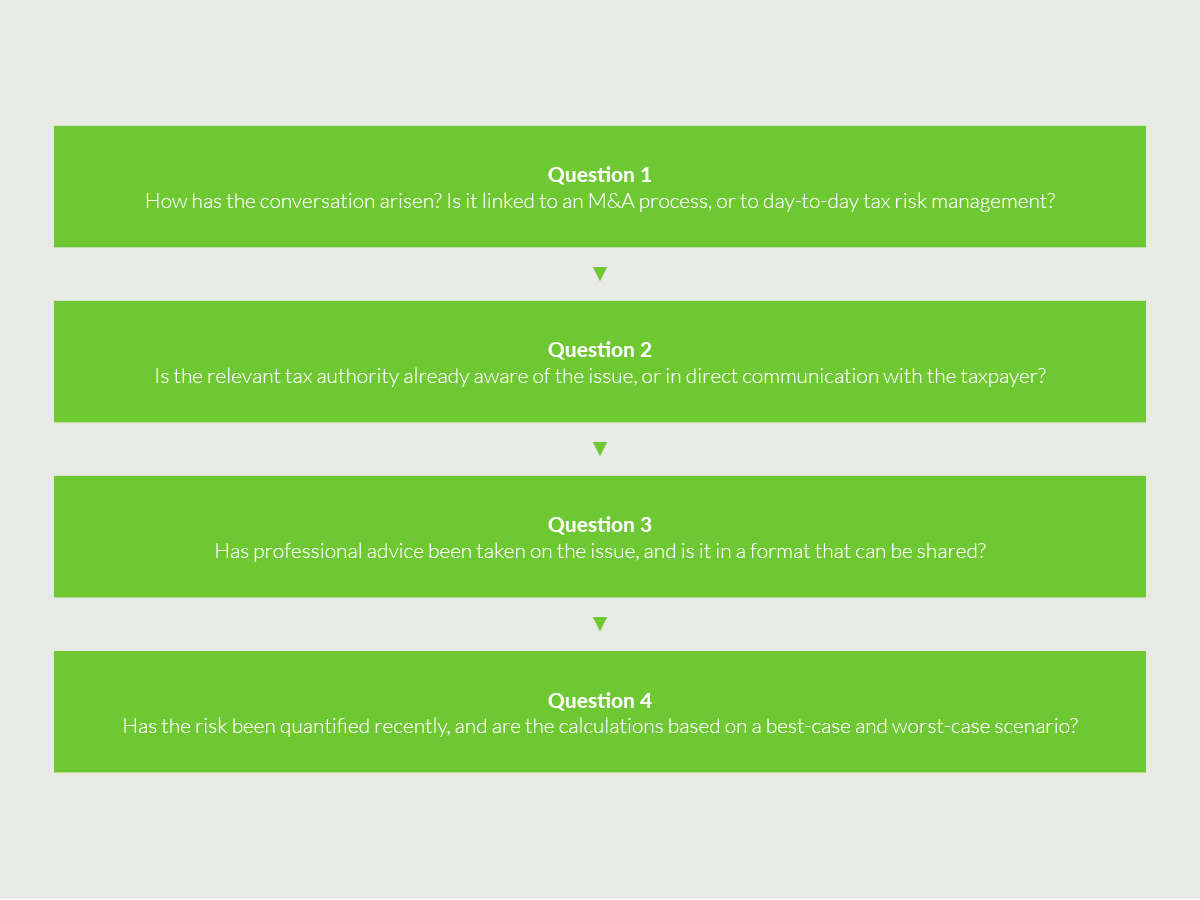
With the right information, Partners& can help clients and advisers assess market appetite quickly, often on a no-names basis or under NDA before a formal process begins.
What is the process and how long does it take?
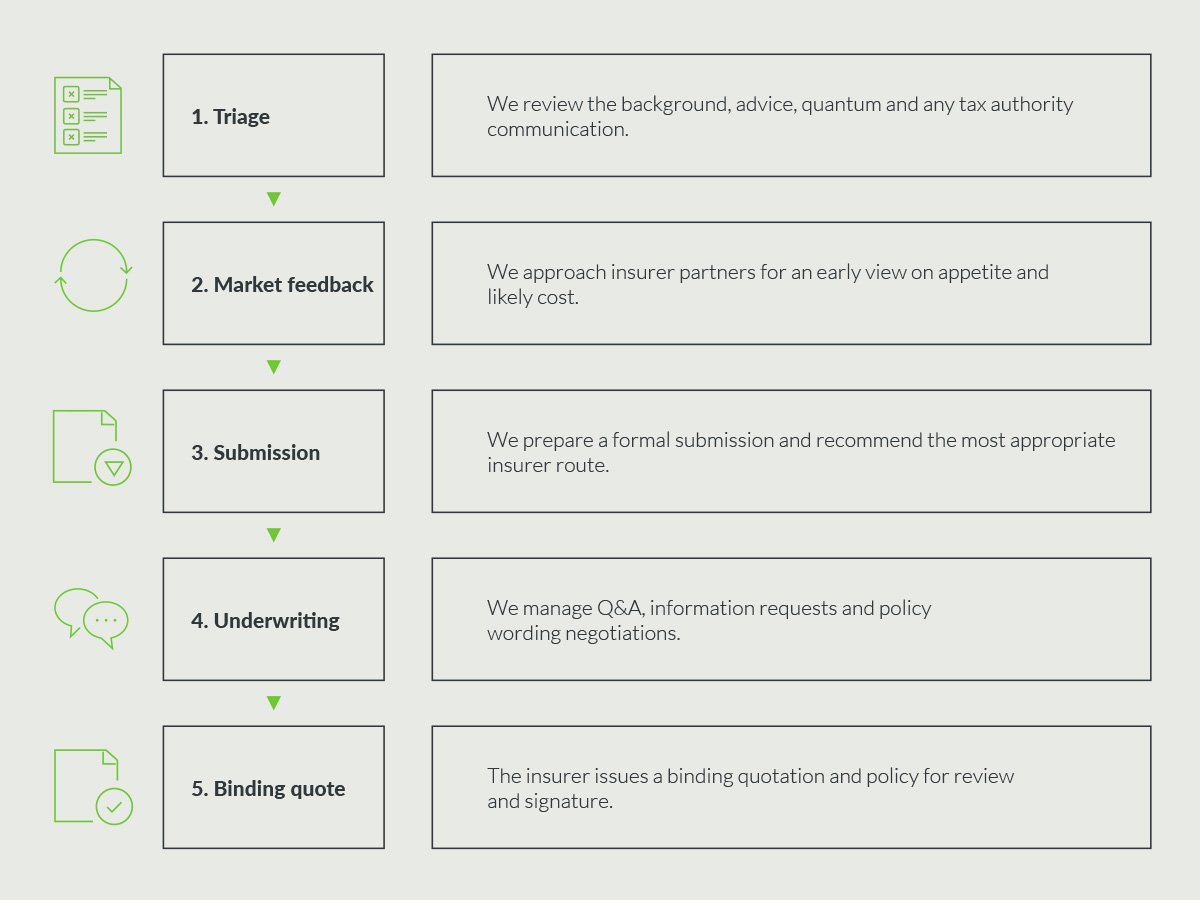
Once NDAs have been signed, the first step is normally to prepare a summary email or hold an introductory call with the Partners& M&A Advisory team. This will cover the triage questions above, together gaining an understand of the commercial background and who are the parties involved.
We then approach insurers for initial feedback on appetite and likely cost, which can typically be obtained in two to three working days.
If the opportunity progresses, we prepare a formal submission, manage insurer engagement and guide the underwriting process. Underwriting typically takes two to three working weeks and involves information requests, Q&A and negotiation of the policy wording to make sure the cover is aligned to the risk and the insured’s needs.
Once underwriting is complete, the insurer will offer a binding quotation and policy, which the client can then accept and sign.
Understanding the cost
The cost of the policy, or premium, varies significantly depending on the nature of the underlying risk. For example, a theoretical UK interpretation risk with little or no discovery or valuation risk may be priced at 1–2% of the amount of insurance required.
A more complex risk, where communication has already taken place between the taxpayer and the tax authority, could be rated at 10–15% of the amount of insurance required.
Most tax insurance policies in the UK are rated between 1.5% and 5% of the amount of cover required. It is rare to see rates above 10%, because insurers are fundamentally seeking to cover risks they believe should be successfully defended, rather than applying ever-increasing premiums to poor risks.
Other costs to consider include insurance premium tax, currently 12% for UK insureds, which is applied to the premium; insurer underwriting fees, which are charged separately to the premium; and broker fees, where applicable.
How Partners& can help
Partners& works with businesses, investors and advisers to make tax insurance part of the wider transaction or risk management strategy, rather than an afterthought. We help clarify the issue, shape the submission, manage insurer questions and negotiate cover that reflects the commercial objective.
If you are planning a transaction, preparing for exit, reviewing a historic tax position or managing a specific tax exposure, our specialist team can help you understand whether tax insurance could provide the certainty you need.
Talk to Partners& about tax insurance
To discuss a specific tax matter, arrange an introduction or explore whether tax insurance could support your transaction or risk management strategy, please get in touch with our specialist team.
Got a question? Want to know more?
Contact our expert